
Disclosure: This post contains affiliate links. If you buy through them, Planty Shanty may earn a small commission at no extra cost to you — it’s what keeps our care guides free. As an Amazon Associate, I earn from qualifying purchases. We only recommend gear we’d put next to our own plants.
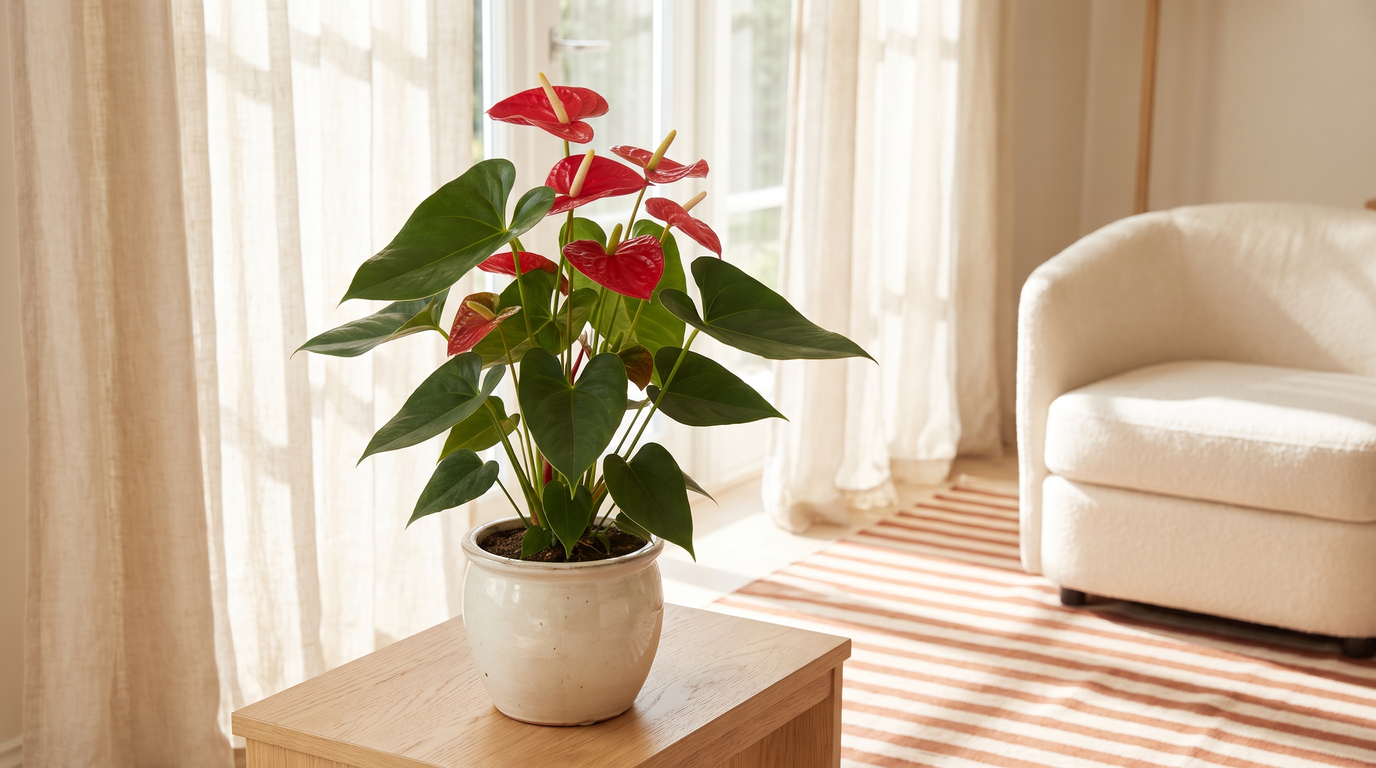
Few houseplants photograph as well as an Anthurium. Those waxy, heart-shaped red “blooms” look almost too perfect to be real — and in a way, they aren’t flowers at all. If you’ve ever wondered why your grocery-store Anthurium stopped blooming, dropped its shine, or started browning at the tips, you’re in the right place. This is the plant that looks fussy but is genuinely easy once you nail two things: light and watering. Let’s get your Anthurium blooming on repeat.
1. Meet the Anthurium
Anthurium (Anthurium andraeanum is the classic flamingo flower you see everywhere) belongs to the aroid family — the same clan as Monstera, Pothos, and Philodendron. That glossy red “petal” is actually a modified leaf called a spathe, and the little tail poking up from it is the spadix, where the true, tiny flowers live.
A few types you’ll run into:
- Anthurium andraeanum — the shiny, heart-shaped flamingo flower in red, pink, white, or coral.
- Anthurium scherzerianum — similar but with a curly, pigtail-shaped spadix.
- Anthurium clarinervium — grown for its dramatic velvety, white-veined foliage rather than blooms.
- Anthurium crystallinum — another stunning foliage type with silver veining.
The blooming types can flower nearly year-round indoors when they’re happy — which is exactly the payoff we’re aiming for.
2. Light Requirements
Light is the number-one lever for blooms. Anthuriums are understory plants from tropical rainforests, so they want brightness without harsh sun.
- Best: bright, indirect light — an east-facing window, or a few feet back from a south or west window.
- Tolerates: medium light, but expect fewer or no blooms.
- Avoid: direct midday sun, which scorches the leaves and fades the spathes.
Too little light is the most common reason an Anthurium refuses to rebloom. If your space is dim, a LED grow light on a timer makes a real difference and keeps that foliage glossy.
3. Watering Routine
Anthuriums like consistent moisture but despise soggy roots — it’s a balance, not a schedule.
- Water when the top inch or two of soil feels dry. Usually about once a week, less in winter.
- Water thoroughly until it drains from the bottom, then empty the saucer — never let it sit in standing water.
- Wilting or drooping often means thirsty; yellowing lower leaves and mushy stems mean overwatered.
Because those thick roots rot easily, take the guesswork out with a cheap soil moisture meter. If your tap water is heavily chlorinated, Anthuriums appreciate filtered or rainwater — they can be a little sensitive to salts.
4. Ideal Soil Mix
Here’s the secret most people miss: Anthuriums are epiphytes, meaning in the wild they cling to trees rather than growing in dense dirt. They want a chunky, airy mix that drains fast and lets roots breathe.
Reach for a loose aroid potting mix, or make your own by combining regular potting soil with generous handfuls of orchid bark and perlite. The goal is a mix that never packs down into a dense, waterlogged brick. Always use a pot with a drainage hole.
5. Fertilizing
To fuel those blooms, Anthuriums appreciate a little help during the growing season. Use a fertilizer formulated for blooming or flowering houseplants — one with a bit more phosphorus encourages spathes.
- Feed every 6–8 weeks in spring and summer, diluted to about half strength.
- Ease off in fall and winter, when growth naturally slows.
Over-fertilizing shows up as brown, crispy leaf tips, so when in doubt, feed lighter.
6. Temperature & Humidity
This is a tropical plant, and it doesn’t hide it.
- Temperature: happiest at 65–80°F. Keep it above 60°F and away from cold drafts, AC vents, and chilly windowsills.
- Humidity: loves it high — 60% or more. Dry indoor air causes browning leaf edges and stalled blooms.
Boost humidity by grouping plants together, setting the pot on a pebble tray, or running a small cool-mist humidifier nearby — bathrooms and kitchens with good light are naturally great Anthurium spots.
7. Repotting
Anthuriums like to be slightly snug, so repot only every 2–3 years, or when you see roots creeping out of the drainage holes or poking above the soil line.
- Move up just one pot size — too big a pot holds excess water and invites rot.
- Spring is the ideal time.
- If aerial roots surface, tuck them under fresh mix or wrap them loosely with damp sphagnum moss.
You can also divide a mature, clumping plant at repotting time for a free second Anthurium — just separate a section with roots attached and pot it up.
8. Common Problems & Pests
- No blooms: almost always too little light, or too much nitrogen fertilizer. Move it brighter and switch to a bloom formula.
- Brown, crispy leaf tips: low humidity, salt buildup, or over-fertilizing. Raise humidity and flush the soil occasionally.
- Yellowing leaves: usually overwatering — check that the roots aren’t sitting wet.
- Faded or greenish spathes: older blooms naturally fade and green out before dropping; trim them off. If new blooms come in green, it usually needs more light.
- Pests: watch for mealybugs, aphids, and spider mites, especially in dry air. Wipe them off and treat with neem oil.
One safety note: Anthuriums are toxic to pets and people if chewed — the sap contains calcium oxalate crystals that irritate the mouth and throat. Keep them out of reach of curious cats, dogs, and toddlers.
Frequently Asked Questions
Why won’t my Anthurium rebloom? Nine times out of ten, it’s light. These plants need consistently bright, indirect light to push out spathes. A bloom-focused fertilizer in spring and summer helps too.
Are the red flowers real flowers? Not exactly — the colorful red part is a spathe (a modified leaf), and the true flowers are the tiny bumps on the tail-like spadix. Cutting the spadix won’t hurt the plant.
How long do the blooms last? Individual spathes can stay colorful for 6–8 weeks or more, and a healthy plant produces new ones throughout the year.
Can I grow Anthurium in just water or moss? Yes — many growers keep them in semi-hydro or pure sphagnum moss because those roots love airflow. Just watch feeding and rinse the medium periodically.
Quick Gear Checklist
- 💧 Soil moisture meter
- 🪴 Aroid potting mix + orchid bark + perlite
- 🌸 Bloom fertilizer
- 💨 Humidifier
- ☀️ LED grow light
- 🐛 Neem oil
Give an Anthurium bright indirect light, an airy mix that never stays soggy, and a little humidity, and it will reward you with those iconic glossy blooms again and again. It’s proof that a plant can be a showstopper and low-drama at the same time. Happy growing, from all of us at Planty Shanty. 🌱
Leave a Reply