
Disclosure: This post contains affiliate links. If you buy through them, Planty Shanty may earn a small commission at no extra cost to you — it’s what keeps our care guides free. As an Amazon Associate, I earn from qualifying purchases. We only recommend gear we’d put next to our own plants.
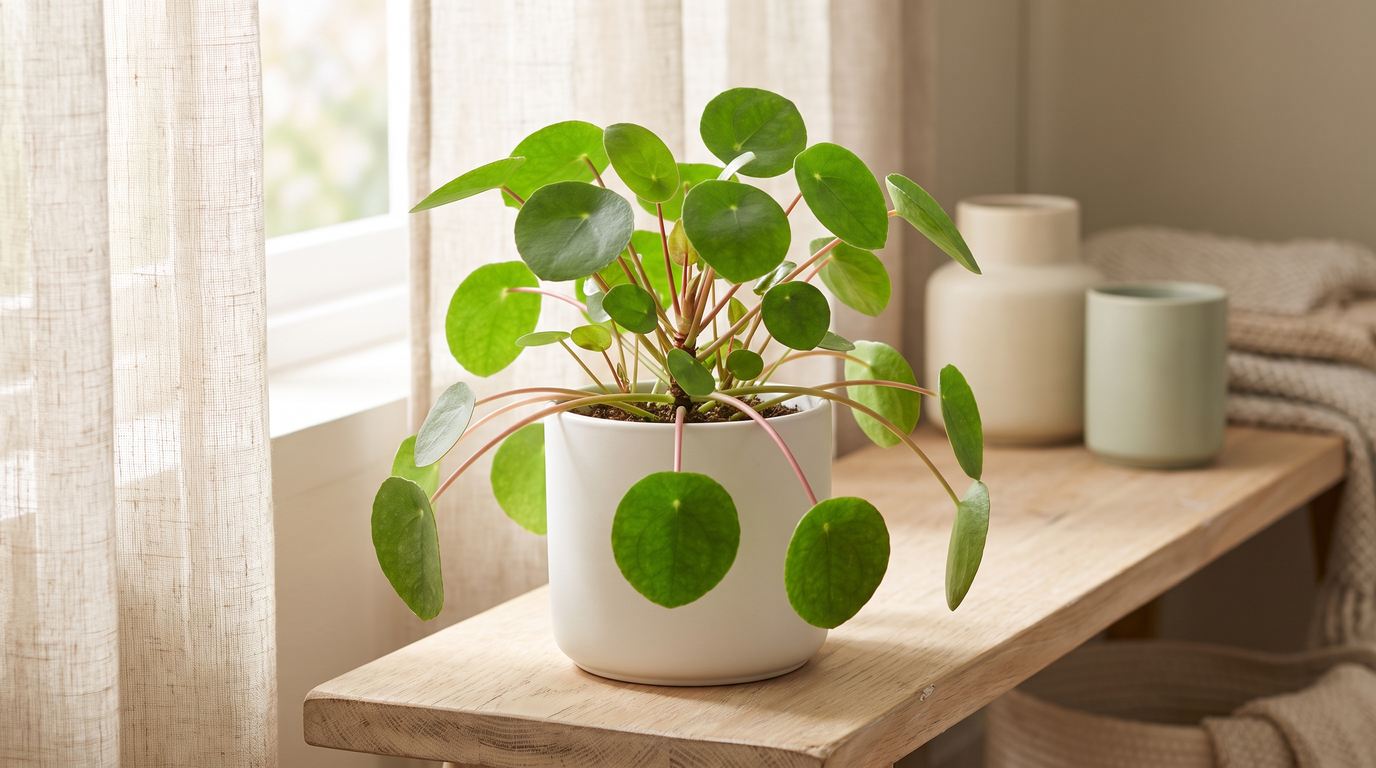
Some plants are impressive. The Pilea is charming. Round, coin-sized leaves held up on skinny stems like a hundred tiny umbrellas, all leaning cheerfully toward the nearest window. It’s the plant that shows up in every well-styled shelfie for a reason: it’s small, it’s sculptural, and it produces babies so generously that one plant eventually turns into gifts for your whole group chat.
The Chinese money plant (Pilea peperomioides) also has a reputation for being a little dramatic — leaves curling, stems flopping, the occasional yellow drop-off. Almost all of that traces back to two things: light and water. Get those right and this is one of the easiest, most rewarding houseplants you can own.
Here’s everything you need to grow a full, upright, pup-producing Pilea.
1. Meet the Pilea
Pilea peperomioides comes from the Yunnan province of southern China, where it grows on shaded, damp rock faces at the base of the Himalayas — a detail worth remembering, because it explains basically all of its preferences: bright but filtered light, moisture that comes and goes, and excellent drainage.
Its journey into our homes is genuinely lovely: a Norwegian missionary brought cuttings home in the 1940s, and for decades the plant spread across Scandinavia purely by people passing pups over the garden fence. It barely existed in the commercial nursery trade until the 2010s. Hence the other nicknames — pass-it-on plant, friendship plant, UFO plant, pancake plant.
What to expect at home:
- Size: 8–12 inches tall and about as wide. A true tabletop plant.
- Growth habit: a single central stem that thickens over time, with leaves on long petioles radiating outward.
- Pups: offsets emerge from the soil around the base and from the stem itself. Constantly. This is the best part.
- Pet safety: non-toxic to cats and dogs. One of the few statement plants you don’t have to hide.
There are a few cultivars floating around — ‘Mojito’ with speckled variegation, ‘White Splash’, and the ruffled ‘Sugar’ — but the classic plain green is the fastest-growing and most forgiving.
2. Light Requirements
Pilea wants bright, indirect light. This is the single biggest lever you have over how good it looks.
- Best: a spot right next to an east-facing window, or a few feet back from a south or west one. Gentle morning sun is perfect.
- Tolerates: medium light, but expect fewer leaves, longer petioles, and a floppier posture.
- Avoid: hot direct afternoon sun, which bleaches and crisps those thin leaves fast.
Two things will tell you the light is wrong. Leaves that curl or dome upward and a stem that stretches with wide gaps between leaves mean it’s reaching for more. Pale, washed-out, or scorched patches mean it’s getting too much direct sun.
The other non-negotiable: rotate the pot a quarter turn every week. Pilea leans toward light more enthusiastically than almost any houseplant, and without rotation you end up with a permanently lopsided plant. This one habit is the difference between a Pilea that looks styled and one that looks like it’s trying to leave.
If you’re working with a dim apartment, a full-spectrum LED grow light on a timer for 10–12 hours a day keeps it compact and full through winter.
3. Watering Routine
Pilea likes a proper soak followed by a real dry-down. It does not like sitting wet — those succulent-ish stems rot quickly.
- Water when the top inch of soil is dry — usually every 7–10 days in spring and summer, stretching to every 2 weeks in winter.
- Water thoroughly until it runs out the drainage hole, then empty the saucer.
- Bottom-watering works beautifully here: set the pot in a shallow tray of water for 15–20 minutes, then let it drain.
Reading the signals:
- Drooping, slightly limp leaves → thirsty. It perks back up within hours.
- Yellow lower leaves that drop, soil still damp → overwatered. Back off immediately.
- Brown crispy edges → too dry, or a dry-air-plus-underwatering combo.
- Leaves curling downward at the edges → often overwatering; curling upward is more often light or heat.
Because Pilea pots are small and dry out unevenly, a cheap soil moisture meter is genuinely useful — the top can feel dry while the root ball is still soaked.
4. Ideal Soil Mix
Fast-draining and airy. Pilea roots are fine and shallow, and they suffocate in dense soil.
Start with a quality indoor potting mix and cut it with a generous handful of perlite — about 3 parts mix to 1 part perlite. A scoop of orchid bark adds even more air if you tend to overwater. Avoid heavy garden soil and anything marketed as moisture-retaining.
Pot choice matters more than usual. Pilea has a small root system, so use a pot only slightly wider than the root ball — 4–6 inches for most plants. Oversized pots stay wet in the middle and cause rot. Terracotta is ideal because it wicks moisture away. And always, always a drainage hole.
5. Fertilizing
Pilea is a light feeder, but it grows fast in season and will use the food.
- Feed every 4 weeks in spring and summer with a balanced liquid houseplant fertilizer at half strength.
- Stop entirely in fall and winter.
- Water first, then feed. Fertilizing dry roots burns them.
Over-fertilizing shows up as brown leaf edges and a white crust on the soil surface. If you see that, flush the pot under the tap for a minute or two and skip a few feedings.
6. Temperature & Humidity
Comfortably average — your living room is probably already right.
- Temperature: 60–75°F. Keep it above 55°F and away from cold windowpanes in winter, heating vents, and AC drafts.
- Humidity: 40–50% is plenty. It appreciates a bit more but doesn’t demand it.
Pilea is more sensitive to cold drafts than to dry air. A plant pressed against a freezing window in January will drop leaves fast. If your winter air is genuinely arid and you’re seeing crispy edges across several plants, a small cool-mist humidifier nearby helps — but don’t mist the leaves directly. Water sitting on those flat surfaces invites fungal spotting.
7. Repotting & Propagating the Pups
Repot every 1–2 years in spring, going up just one pot size. Signs it’s time: roots circling the bottom, water running straight through, or growth stalling in good conditions.
Refresh the top inch of soil each spring even in years you don’t repot.
Now the fun part. Pilea produces two kinds of offsets:
- Root pups push up through the soil a few inches from the mother plant. Once one is 2–4 inches tall, dig down with a clean knife, cut it away with a bit of root attached, and pot it in its own small container of the same mix.
- Stem pups appear directly on the main stem. Slice them off flush with a clean blade and root the cutting in water — a jar on the windowsill, roots in 2–3 weeks — then pot up. A dab of rooting hormone speeds soil-rooting along.
Use clean, sharp pruning shears or a snips-style blade so you don’t crush the tissue. Removing pups also pushes the mother plant to put energy into its own leaves — so harvesting is good for both.
If your Pilea has gone leggy with a bare lower stem, don’t panic: that’s normal maturity. You can either lean into the little-tree look, or behead the top, root it, and start fresh.
8. Common Problems & Pests
- Leaves curling or doming upward: usually too much light or heat; sometimes underwatering. Move it slightly back from the window.
- Yellowing lower leaves dropping off: overwatering is the usual culprit. Some loss of the oldest leaves is normal.
- Leggy stem, sparse leaves: not enough light, plus no rotation. Brighten it up and start turning the pot weekly.
- Leaning hard to one side: rotate the pot. Every week. That’s the whole fix.
- Brown crispy edges: dry air, fertilizer salt buildup, or inconsistent watering. Flush the soil and even out your rhythm.
- Sudden collapse with mushy stem base: root rot. Unpot immediately, cut away black mushy roots, repot in fresh dry mix — and salvage any healthy pups as insurance.
- Pests: fungus gnats are the most common, and they’re a symptom of soil kept too wet — let it dry out and top with a layer of coarse sand. Also watch for spider mites in dry air and the occasional mealybug in leaf joints. Wipe with rubbing alcohol on a cotton pad, then treat with neem oil weekly until they’re gone.
Frequently Asked Questions
Why is my Pilea’s stem so long and bare at the bottom? That’s normal aging — Pilea drops its oldest lower leaves as the trunk thickens. Insufficient light accelerates it. Move it brighter, keep rotating, and either enjoy the tree shape or propagate the top and restart.
Why aren’t my leaves round and flat anymore? Curling and doming almost always mean light stress — too much direct sun, or heat from a nearby vent or radiator. Move it a foot or two back from the glass and the new leaves will come in flat.
How do I get my Pilea to make more babies? Good light, a snug pot, consistent watering, and light feeding in spring and summer. Healthy mature plants pup readily; a stressed one puts everything into survival instead.
Are Chinese money plants safe for cats and dogs? Yes — Pilea peperomioides is considered non-toxic to pets and people. Nibbling still isn’t great for anyone, but it’s not a danger.
Can I propagate Pilea from a single leaf? Not reliably. Unlike some Peperomia, a Pilea leaf without a piece of stem or root rarely produces a new plant. Stick to root pups and stem pups.
Why does my Pilea have white spots on the leaves? Often mineral deposits from hard water or fertilizer salts, which wipe off. Fuzzy or raised spots that don’t wipe away point to mealybugs or a fungal issue instead.
Quick Gear Checklist
- 💧 Soil moisture meter
- 🪴 Indoor potting mix + perlite
- 🏺 Terracotta pots with drainage for the pups
- 🌿 Liquid houseplant fertilizer
- ✂️ Pruning shears
- 🌱 Rooting hormone
- ☀️ LED grow light
- 💨 Humidifier
- 🐛 Neem oil
Bright indirect light, a snug pot that drains, a weekly quarter turn, and a soak-then-dry rhythm — that’s the whole Pilea playbook. Do that and within a year you’ll have more baby plants than windowsills. Which is, honestly, the correct number. Happy growing, from all of us at Planty Shanty. 🌱
Leave a Reply