
Disclosure: This post contains affiliate links. If you buy through them, Planty Shanty may earn a small commission at no extra cost to you — it’s what keeps our care guides free. As an Amazon Associate, I earn from qualifying purchases. We only recommend gear we’d put next to our own plants.
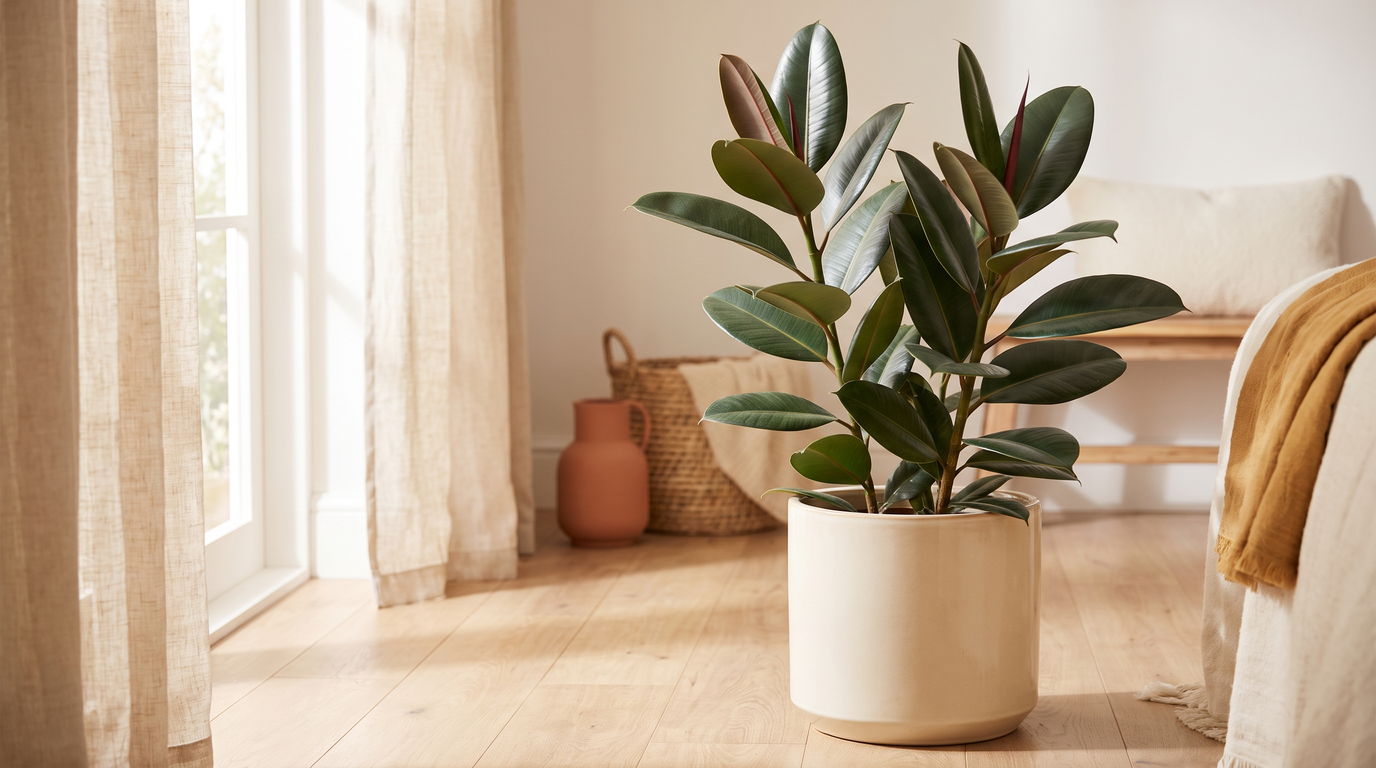
There’s a moment every plant person hits where the little pots on the windowsill aren’t enough anymore and you want presence — something with a trunk, something that fills the empty corner next to the sofa. That’s the rubber plant. Big, patent-leather leaves in deep green or burgundy, a habit that goes from tabletop to ceiling-scraper in a few years, and — unlike its famously moody cousin the fiddle leaf fig — a temperament that actually forgives you.
If you’ve been eyeing one at the garden center, or you brought one home and it’s dropping leaves and you’re panicking a little: this is your guide. Let’s get that Ficus glossy.
1. Meet the Rubber Plant
Ficus elastica is native to the forests of South and Southeast Asia, where it grows into a genuinely enormous tree — 100 feet plus. Indoors it stays a very manageable 6–10 feet, and you’re in full control of that with pruning. The common name comes from its milky white sap (latex), which was once tapped for rubber production. That same sap is why the plant is mildly toxic and why pruning gets a little drippy — more on both later.
The varieties you’ll actually run into:
- ‘Robusta’ — the classic, with wide deep-green leaves. The most forgiving of the bunch.
- ‘Burgundy’ (sometimes sold as ‘Black Prince’) — near-black leaves with a red midrib. Stunning, and needs a bit more light to hold that color.
- ‘Tineke’ — variegated cream, green, and gray. Slower-growing and thirstier for light.
- ‘Ruby’ — pink-and-cream variegation. The showstopper, and the fussiest.
Buy the plainest variety if you’re new to Ficus, and the variegated ones once you’ve got a bright spot to spare. Variegated leaves have less chlorophyll, which means less margin for error in a dim room.
2. Light Requirements
Rubber plants want bright, indirect light — think a spot a few feet back from a south or west window, or right in an east-facing one where they’ll catch gentle morning sun.
- Best: bright and indirect, ideally 6+ hours a day.
- Tolerates: medium light, with slower growth and more spacing between leaves.
- Avoid: harsh direct afternoon sun, which scorches those big leaf surfaces into pale bleached patches.
Here’s the tell that your plant wants more light: leggy growth. If the stem is stretching with big bare gaps between leaves, or the lower leaves are yellowing and dropping while new ones come in small, it’s reaching for a window it can’t find. Variegated types will also fade toward plain green in low light.
Dark apartment? A full-spectrum LED grow light on a timer for 10–12 hours a day genuinely fixes this. And rotate the pot a quarter turn every couple of weeks so it grows straight rather than leaning like it’s trying to escape.
3. Watering Routine
This is where most rubber plants get into trouble, and the fix is simple: water thoroughly, then let it dry down.
- Water when the top 1–2 inches of soil feel dry — usually every 7–14 days in spring and summer, and noticeably less in winter.
- Soak until water runs out the drainage hole, then dump the saucer. Never let the pot sit in a puddle.
- In winter, back off. Cool temperatures plus wet soil is the fastest way to root rot.
Rubber plants are quiet about being thirsty and loud about being overwatered. Drooping leaves usually mean underwatered. Yellow lower leaves that drop, plus soil that never seems to dry means overwatered — and that’s the one that kills.
Because those big pots dry unevenly, a cheap soil moisture meter takes the guessing out of it. Push it deep, not just into the top inch.
4. Ideal Soil Mix
Rubber plants aren’t precious about soil — they just need it to drain fast. A dense, water-retentive mix in a big pot is the classic rot setup.
Start with a quality indoor potting mix and lighten it up with a generous scoop of perlite — roughly 3 parts soil to 1 part perlite. If you already keep aroids, a chunky aroid potting mix works beautifully here too.
Drainage hole, always. If you’re using a pretty cachepot with no hole, keep the plant in its plastic nursery pot and slip it inside — that way you can water at the sink and let it drain properly.
5. Fertilizing
Rubber plants are fast growers when they’re happy, and they’ll use the food.
- Feed every 4–6 weeks in spring and summer with a balanced liquid houseplant fertilizer, diluted to half strength.
- Stop feeding in fall and winter while growth slows down.
- Always water first, then feed — fertilizing bone-dry roots can burn them.
Brown crispy leaf edges on a plant that’s otherwise well-watered often means salt buildup from fertilizer. Flush the pot with plain water in the sink for a minute or two every few months and that problem goes away.
6. Temperature & Humidity
Good news: your house is probably already right.
- Temperature: 60–80°F is the sweet spot. Keep it above 55°F, and away from cold drafts, radiators, and AC vents.
- Humidity: average household humidity (around 40–50%) is fine. It won’t say no to more.
The real enemy is sudden change. A rubber plant moved abruptly from a humid greenhouse to a dry living room, or parked next to a drafty door in January, will drop leaves in protest. That’s usually shock, not death — put it somewhere stable, keep watering normally, and it recovers.
If your winter air is desert-dry and you’re seeing crispy edges, a small cool-mist humidifier nearby helps.
7. Repotting & Pruning
Repot every 2–3 years, in spring, when roots start circling the pot or poking out of the drainage holes.
- Go up just one pot size (about 2 inches wider). An oversized pot holds water the roots can’t use.
- Terracotta is a great choice here — it breathes and dries faster.
- Once the plant is too big to repot comfortably, just top-dress: scrape off the top 2 inches of old soil and replace it with fresh mix each spring.
Pruning is your superpower with this plant. Rubber plants naturally grow as a single unbranched stalk unless you intervene. Cut the top off (any time in spring or summer) and the plant pushes out two or more new branches just below the cut — that’s how you get a full, tree-shaped specimen instead of a lonely pole. Use clean, sharp pruning shears.
Two things to know: the cut will ooze white latex sap, so lay down newspaper and wear gloves — it’s sticky and it irritates skin. And that cutting you just took? Root it in water or moist soil and you’ve got a free second rubber plant.
While you’re at it, wipe the leaves. Those big glossy surfaces collect dust fast, and dust blocks light. A damp microfiber cloth every few weeks keeps them shining and lets the plant actually photosynthesize.
8. Common Problems & Pests
- Dropping leaves: the signature rubber plant complaint. Causes, in order of likelihood: sudden environment change, cold draft, overwatering, or a big swing in light. Stabilize conditions and stop fussing.
- Yellowing lower leaves: almost always overwatering. Check that the soil isn’t staying wet for more than a week.
- Brown crispy edges: low humidity, salt buildup, or underwatering. Flush the soil and check your watering rhythm.
- Pale bleached patches: sunburn from direct afternoon sun. Move it back from the glass.
- Leggy stem, small new leaves: not enough light. Move it brighter and prune the top to force branching.
- Pests: scale is the big one on Ficus — look for small brown bumps along stems and leaf undersides. Also watch for spider mites in dry air and the occasional mealybug. Wipe them off with rubbing alcohol on a cotton pad, then treat with neem oil, repeating weekly until they’re gone.
Safety note: the milky sap is mildly toxic to cats, dogs, and humans if chewed, and can irritate skin on contact. Keep it out of reach of pets and toddlers, and glove up when pruning.
Frequently Asked Questions
Why is my rubber plant dropping leaves? Nine times out of ten it’s a change — you just brought it home, moved it, or the seasons turned and a draft found it. Give it a consistent spot with good light, water on a dry-down schedule, and stop moving it. New growth usually resumes within a few weeks.
How do I make my rubber plant bushy instead of a single tall stalk? Prune the top. Cutting the main stem in spring or summer forces the plant to branch below the cut. You can repeat this as it grows to build a full canopy.
How fast do rubber plants grow? In good light, surprisingly fast — 12–24 inches a year is normal, and they can reach 6–10 feet indoors. Pruning keeps them at whatever height you want.
Can I propagate a rubber plant from a cutting? Yes. Take a stem cutting with 2–3 leaves, rinse off the sap, and root it in water or moist potting mix with a little rooting hormone. Roots typically appear in 3–6 weeks. Air layering works even better on thick stems.
Are rubber plants safe for cats and dogs? No — the sap is mildly toxic and irritating if chewed. It’s not usually life-threatening, but it’s worth placing this one out of reach.
Why are my variegated leaves turning plain green? Not enough light. Variegated cultivars like ‘Tineke’ and ‘Ruby’ need brighter conditions to hold their pattern.
Quick Gear Checklist
- 💧 Soil moisture meter
- 🪴 Indoor potting mix + perlite
- 🌿 Liquid houseplant fertilizer
- ✂️ Pruning shears
- 🌱 Rooting hormone for propagating cuttings
- ☀️ LED grow light
- 💨 Humidifier
- 🐛 Neem oil
Give a rubber plant bright indirect light, a pot that drains, and the confidence to prune it, and it will turn into the tree-sized statement piece your corner has been waiting for. It’s one of the few big-impact houseplants that genuinely forgives a missed watering. Happy growing, from all of us at Planty Shanty. 🌱
Leave a Reply